
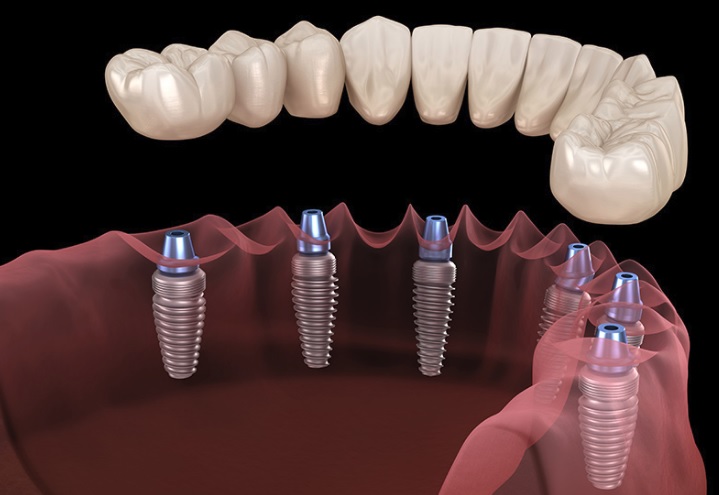
For people missing most or all of their teeth in one jaw, a full-arch implant bridge or an implant-supported denture may be an option. These use several dental implants to support a set of replacement teeth.
Compared with standard dentures
- Standard dentures rest on the gums, are removable and cost less, but some people find them loose.
- Implant-supported teeth are held by implants, which some people find more stable. They involve surgery, healing time and higher cost.
Both options need ongoing care and eventual maintenance or replacement.
What treatment involves
- Assessment, X-rays and a 3D scan.
- Removal of any remaining teeth, if needed.
- Placement of several implants under anaesthetic.
- Temporary teeth during healing, then the final bridge or denture.
Care
Daily cleaning around the implants and regular professional reviews are essential. Some designs are removable for cleaning; fixed designs need special cleaning aids.
Risks
Risks include pain, swelling, infection, nerve injury, sinus problems and implant failure. Smoking and diabetes increase risk. Complex cases may be referred to a specialist.
Related articles
- Mini Dental Implants Explained
- Tooth Implant vs Bridge: Comparing Your Options
- How Is a Dental Implant Placed?
This article is general information only and does not replace advice from your own dentist. Whether a treatment is suitable for you can only be decided after an examination. All dental treatment carries risks, and results vary from person to person. Any surgical or invasive procedure carries risks. Before proceeding, you should seek a second opinion from an appropriately qualified health practitioner.