
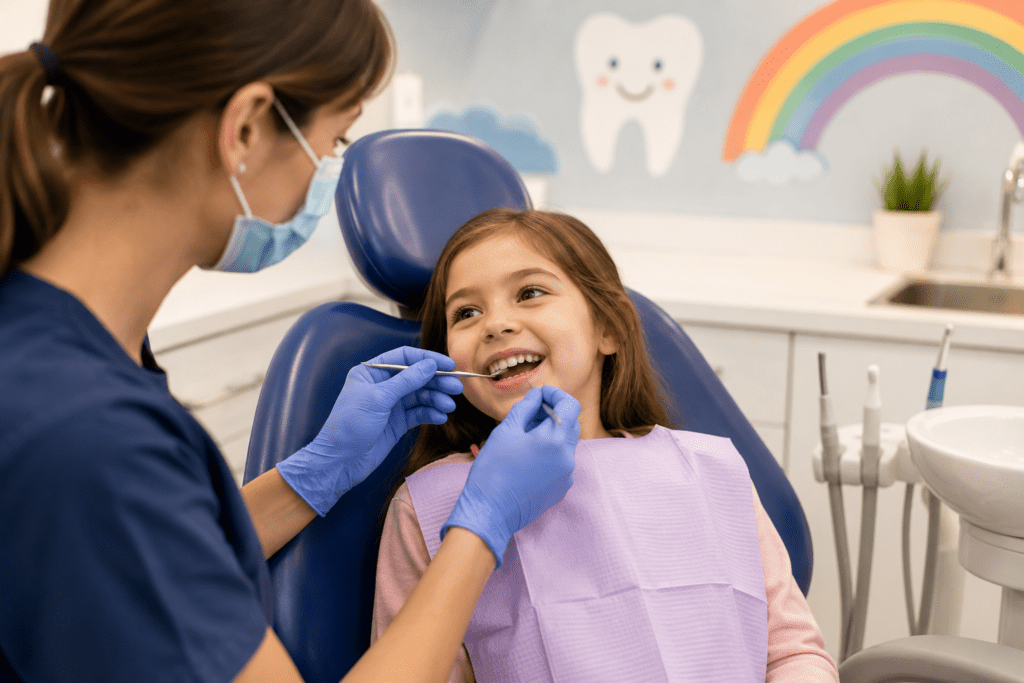
Healthdirect recommends a child’s first dental visit at around 12 months of age, or when their first teeth appear. At that age the visit is short and gentle: the dentist looks at your child’s teeth and gums, checks for early signs of decay, and gives you practical tips for cleaning, feeding and fluoride.
Starting early helps your child get used to the dental chair before there’s ever a problem. It also sets up the habit of regular check-ups, which you can read about in our guide to dental check-ups.
When should your child have their first dental visit?
Aim for around the first birthday, or when the first tooth comes through if that’s earlier. Don’t wait until all the baby teeth are in or until something hurts. Decay in baby teeth can develop quickly, and early visits give your dentist a chance to spot chalky white patches or brown spots while they can often still be managed.
Baby teeth matter. They help your child chew, speak clearly and hold space for the adult teeth that follow. Losing them early to decay can affect how those adult teeth come through.
What happens at the appointment
A first visit is mostly about getting comfortable. Your dentist will usually:
- ask about your child’s health, feeding, sleeping and teeth-cleaning routine
- look at the teeth, gums, tongue and the way the jaws are developing
- check for early decay, injuries and habits such as thumb sucking or dummy use
- show you how to brush your child’s teeth and which toothbrush to use
- talk about diet, drinks and fluoride, and when to come back
Toddlers often aren’t cleaned or X-rayed at a first visit unless there’s a specific reason. The aim is a calm, positive experience.
The knee-to-knee exam
For babies and toddlers, many dentists use a knee-to-knee position. You sit facing the dentist with your knees touching theirs. Your child sits on your lap facing you, then lies back so their head rests in the dentist’s lap. You hold your child’s hands, and they can see you the whole time. This lets the dentist see inside the mouth quickly while your child feels secure. A few tears are common at this age and are no cause for worry.
How to prepare your child
- Book a good time. Choose a time when your child is usually rested and fed, often the morning for little ones.
- Read and play. Picture books about visiting the dentist can help. Take turns counting each other’s teeth with a toothbrush, or let a teddy have a check-up first.
- Keep it simple. Tell your child the dentist will count their teeth and see how strong they are. Too much detail can create worry.
- Stay calm yourself. Children pick up on how parents feel. If you are anxious about dentists, try not to share that in front of them.
- Bring comfort. A favourite toy or blanket can help.
Words to avoid
Some words can make a visit sound frightening, even when you mean to reassure. Try to avoid hurt, needle, shot, drill and scary, and phrases like “don’t be scared” or “it won’t hurt”, which put the idea in a child’s head. Use positive, simple language instead, such as “the dentist will look at your teeth” or “they’ll count your teeth with a little mirror”.
Please avoid using the dentist as a threat, for example “if you don’t brush, the dentist will pull your teeth out”. It can make future visits harder.
Bottle and sippy-cup habits that protect teeth
What and how your child drinks has a big effect on their teeth. Milk, formula and juice all contain sugars, and sipping on them for long periods keeps teeth bathed in sugar. Helpful habits include:
- don’t put your child to bed with a bottle of milk, formula or juice
- if your child needs a drink overnight or between meals, offer plain water
- introduce a cup from around 6 months and, as is commonly advised, start phasing out bottles from about 12 months
- avoid letting your child walk around sipping from a bottle or sippy cup all day
- skip juice and soft drinks, and make tap water the everyday drink
- never dip a dummy in honey, jam or anything sweet
Brushing and fluoride toothpaste for young children
Start cleaning as soon as the first tooth appears, using a soft, small children’s toothbrush or a clean, damp cloth. Brush twice a day, including last thing at night. Children usually need a parent to brush or help until they can do it well themselves, often around 7 or 8 years old.
Fluoride toothpaste guidance generally recommended in Australia is:
- Under 18 months: don’t use toothpaste unless your dentist or health professional advises it. Brush with water only.
- 18 months to 6 years: use a pea-sized amount of low-fluoride children’s toothpaste. Encourage your child to spit it out, not swallow it, and don’t rinse afterwards.
Your child’s needs may be different, so ask your dentist what suits them. This kind of preventive dentistry is one of the simplest ways to help protect young teeth.
Children’s dental visits in North Sydney
Our children’s dentistry appointments are relaxed and unhurried, with time for questions. Many parents book their child’s first dental visit alongside their own check-up at our North Sydney practice, so kids can watch first.
The Child Dental Benefits Schedule is a Medicare program that may cover some basic dental services for eligible children, depending on your family’s circumstances. Ask us whether it applies. Many health funds also pay benefits for children on a family policy, so check with your fund.
If your child has a knocked-out or broken tooth, severe pain or swelling, see a dentist promptly. Our emergency dentist page explains what to do. Call 000 or go to hospital for difficulty breathing or swallowing, or facial swelling that is spreading quickly. For teething or toothache, children’s pain relief should only be given as directed on the pack for their age and weight, or as advised by a pharmacist.
Frequently asked questions
At what age should my child first see a dentist?
Healthdirect recommends a first check-up at around 12 months of age, or when the first teeth appear. Starting early helps your child get used to visits and lets your dentist spot problems while they are small.
How long does a child’s first dental visit take?
A first visit for a toddler is usually short, as the focus is on a quick look at the teeth and practical advice for parents. Your dentist will go at your child’s pace.
What if my child cries during the visit?
Crying is common for babies and toddlers and is not a sign the visit has gone badly. The knee-to-knee position lets your dentist check the teeth quickly while your child stays close to you.
Is the Child Dental Benefits Schedule available?
The Child Dental Benefits Schedule may cover some basic dental services for eligible children, depending on your family’s circumstances. Ask us whether it applies to your child before the visit.
Book your check-up
North Sydney Dentistry is at Level 1, Suite 102/71 Walker St, North Sydney, a two-minute walk from North Sydney station. We’re open Monday to Friday, 9am to 6pm. Call (02) 8090 1108 or book online.
This article is general information only and is not a substitute for advice from your own dentist or doctor. Any surgical or invasive procedure carries risks. Before proceeding, you should seek a second opinion from an appropriately qualified health practitioner.